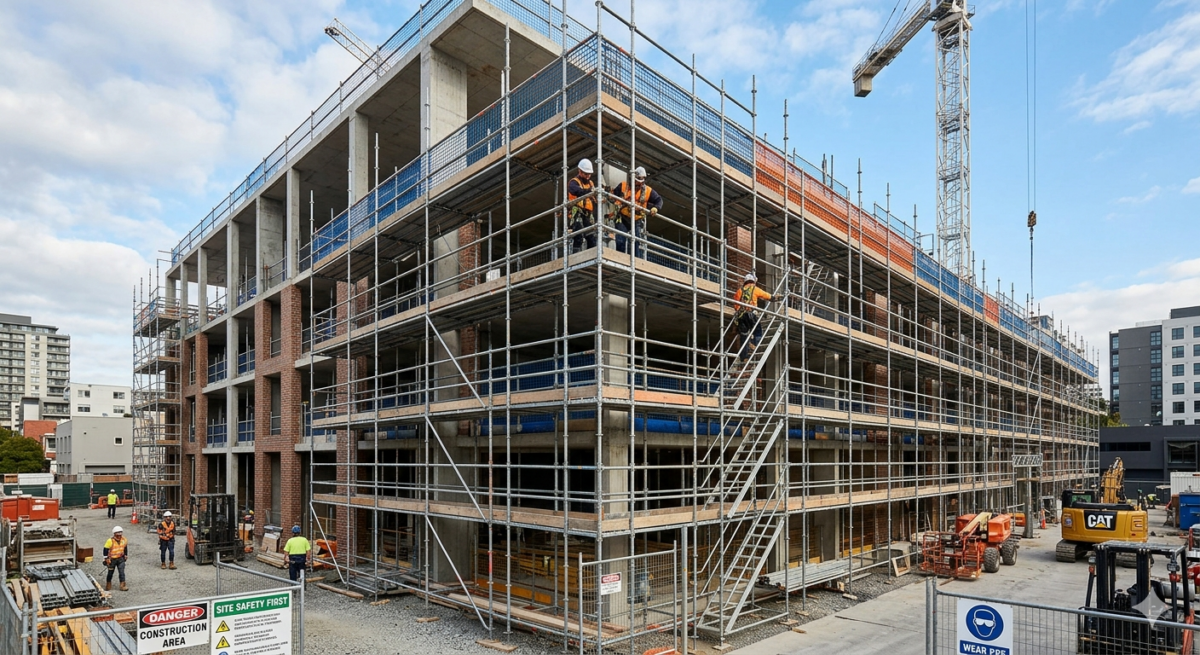
Scaffolding is basically a temporary structure that has uses in various places, such as in construction, the mechanical industry, for maintenance, repair, etc. Scaffolding gives safe access to heights and difficult areas for workers and inspectors. So, choosing the right types of scaffolding is very important for safety, productivity, and project budget.
In this explanation, we’ll explain the major types of scaffolding used in construction along with their advantages, disadvantages, and common uses.
Single Scaffolding (Bricklayer Scaffolding)
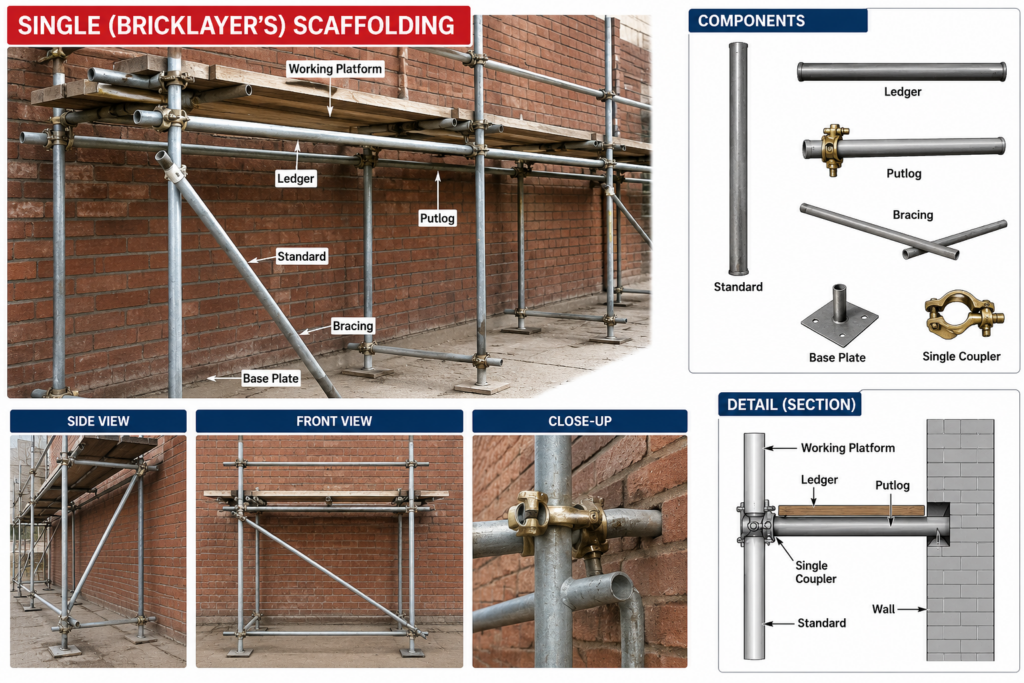
Normally, single scaffolding is used in masonry work. This type of scaffolding consists of a single framework of standards(vertical), ledgers, transom, and putlogs connected together.
Features:
- One row of standard poles
- Putlogs inserted into wall holes
- Used for small or medium-duty work only
Double Scaffolding (Mason Scaffolding)
Double scaffolding uses two rows of scaffolding poles for extra strength.
Common Uses:
Stone masonry
Heavy-duty work
Benefits:
The load capacity is more and more stable than that of single scaffolding
Cantilever Scaffolding
It’s a very interesting types of scaffolding, it is used when we can’t use the ground to make the scaffolding from. There is another name of this type of scaffolding is “Needle scaffold”, because the ‘needle’ supports the entire scaffold structure. It uses plan bracing. Cantilever scaffolding is supported at one end while the other end extends outward.
Common Uses:
Projects where ground space is limited
Areas with obstacles
Advantages:
Useful in restricted spaces
Need less material
Saving time
Disadvantages:
Requires expert design and supervision
Suspended scaffolding
Suspended scaffolding is hung from the top of a building using ropes, chains, or wires. In this type of scaffolding, the use of wire ropes or chains help us to hang the platform from the top. We can raise and down the platform by the chains or ropes.
Common Uses:
High-rise building maintenance
Glass cleaning
Painting tall buildings
Exterior repairs
Advantages:
Ideal for tall buildings
Less ground space required
Disadvantages:
Requires skilled workers. Higher safety risk if improperly installed.
Mobile Scaffolding:
Mobile scaffolding is a types of scaffolding that has mobility power. It has wheels at the base that allow it to move easily from one place to another place.
Common Uses:
Indoor maintenance
Electrical work
Warehouse repairs
Painting
Advantages:
Highly mobile
Saves labor time
Disadvantages:
Not suitable for uneven surfaces
Tube and Coupler Scaffolding
This scaffolding uses steel tubes/pipes and couplers/clamps for connections.
Common Uses:
Complex industrial projects
Custom structures
Advantages:
Highly flexible
Strong and durable
System Scaffolding
System scaffolding is also known as modular scaffolding. This types of scaffolding is not as flexible as tubular scaffolding but is less time-consuming. The components for this types of scaffolding are pre-built verticals and horizontals. We have to connect these components in a systematic way to construct the scaffolding.
Advantages:
The advantage of this types of scaffolding is that they do not require a high degree of skill to erect them, because, the location of the connections is fixed. This is why, this types of scaffolding is very useful for construction industries.
In the below, we have listed most popular types of systems scaffolding like:
- Cuplock scaffolding
- Kwik stage Scaffolding
- Staircase Tower
Cuplock scaffolding System– Types of scaffolding in construction
The Cuplock scaffolding is a heavy-duty scaffolding. This types of scaffolding is very easy to set up, and it is less time-consuming. For this reason, this types of scaffolding has very good demand in modern industries. Because it saves time and money. So, most of company prefer this types of scaffolding for construction and maintenance work. The cuplock system is an ideal solution for facade scaffolds, birdcage structures, modular staircases, and mobile towers, etc.
Kwikstage scaffolding System– Types of scaffolding in construction
This types of scaffolding is very similar to cuplock scaffolding. The main basic components are vertical, ledgers, a jack, and a hooking board. The only difference between cuplog and kwikstage is in the locking system. Here, verticals have V-shaped fittings, where we see a cup in the cuplock scaffolding. The ledgers fit into these fittings. The transoms also use the V-shaped fittings to link the inner and outer standards.
Modular Stair Case scaffolding- Type of scaffolding
This types of scaffolding is made to provide access to the main scaffolding platform or somewhere for work, as it is considered safer than using a normal ladder. Simultaneously, the Modular Staircase is useful to work independently from its own platform for small works like fixing light…etc. Workers can carry small materials, tools, or other equipment with them, which is safer than carrying them up a ladder. A modular staircase is used to make temporary access to reach the high elevation of a building.
For any other blogs, you can visit our blogs page