

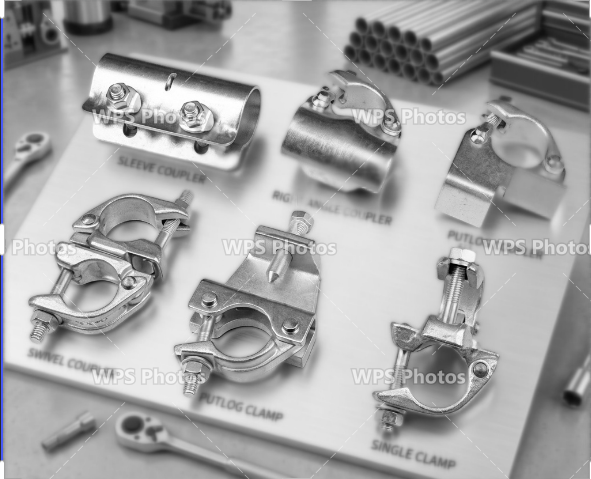
Scaffolding clamps (also called scaffold couplers or fittings) are metal devices that join steel scaffold tubes together to build a secure temporary structure【7†L68-L72】. These clamps lock around tubes using bolts, creating rigid connections between horizontal and vertical members of the scaffold frame. In practice, high-grade, properly installed clamps ensure the entire scaffold can safely carry workers, equipment, and materials. According to OSHA, tube-and-coupler scaffolds “are built from tubing connected by coupling devices”【3†L280-L287】, so the quality of those clamps directly affects safety. This guide explains all aspects of scaffolding clamps – from the different types (right-angle, swivel, putlog, beam, etc.) to safety standards, selection tips, common errors, and maintenance best practices. By understanding clamp types and following industry standards, contractors and safety officers can build stronger, more reliable scaffolds that comply with regulations【7†L68-L72】【3†L280-L287】.
What Are Scaffolding Clamps?
A scaffolding clamp (or coupler) is a mechanical fastener that securely connects two or more scaffold tubes【7†L68-L72】. Each clamp typically consists of two semi-circular halves bolted together, clamping around the intersecting tubes. These clamps form the backbone of tube-and-coupler scaffolding systems by holding together the horizontal ledgers, vertical standards, and diagonal braces. Because scaffolding transfers heavy loads and dynamic forces, using properly rated steel couplers is critical【7†L68-L72】【3†L280-L287】. For example, OSHA specifies that couplers must be made of high-strength drop-forged steel, malleable iron, or aluminum alloy – cast-iron clamps are expressly forbidden due to their brittleness【3†L280-L287】【3†L288-L291】. In summary, scaffolding clamps (couplers) keep the scaffold stable; without them, even strong tubes could separate under load.
Types of Scaffolding Clamps
There are several main types of scaffold clamps, each designed for a specific connection or application:
- Right-Angle (Double) Coupler: Connects two scaffold tubes at a 90° angle【7†L98-L101】. This is the most common clamp, used to join horizontal ledgers to vertical standards. Drop-forged right-angle clamps provide very high shear strength and are used for primary load-bearing connections【7†L98-L101】【19†L178-L186】.
- Swivel (Universal) Coupler: Joins two tubes at any angle【7†L103-L107】. Swivel clamps have a single bolt and a pivoting joint, allowing for non-rectangular angles. They are ideal for diagonal bracing where the angle changes, but should be used only for stabilization (not vertical load) in a scaffold【7†L103-L107】【19†L178-L186】.
- Putlog (Transom) Coupler: Attaches ledger tubes to transoms or to holes in walls【7†L108-L112】. Putlog clamps are typically used where a horizontal scaffold member (ledger) meets a wall or a fixed tube. They support the scaffold platform (planks) and carry comparatively light loads【7†L108-L112】.
- Beam (Girder) Coupler: Secures a scaffold tube to a structural steel beam or girder【19†L106-L114】. Girder clamps have larger jaws to grip I-beams; they are used to anchor the scaffold to existing structures for added support. These clamps are rated for very high loads on the beam【22†L253-L259】【19†L106-L114】.
- Sleeve (End-to-End) Coupler: Joins two scaffold tubes end-to-end to extend their length【7†L113-L115】. Also called an “alignment” coupler, it creates a straight joint between two sections of tube. These clamps have weaker load ratings (since they only resist direct pull-out) but are useful for extending poles.
- Board Retaining Clamp: Holds scaffold boards or planks in place on the ledgers【43†L121-L124】. This clamp bolts to a ledger and has a retainer plate, preventing platform planks from sliding off. Board clamps are safety accessories that improve platform stability and prevent accidents【43†L121-L124】.
- 5. Ladder Clamp: A specialized clamp that secures a portable ladder to the scaffold frame for safe access. Ladder clamps come in pressed-steel or forged-steel versions, often double-sided, with hooks or plates for the ladder stiles. Using at least two clamps (top and bottom) per ladder section ensures it cannot slip. These clamps must fit standard scaffolding tube sizes (usually 48.3mm OD) and meet standards like BS1139 and EN74.
Many clamps come in either pressed-steel or drop-forged steel designs. For high-stress joints, always use heavy-duty drop-forged couplers【19†L189-L191】. Below is a quick reference table of common clamp types and their uses:
| Clamp Type | Use/Application |
| Right-Angle (Double) | Joins horizontal ledgers to vertical standards (at 90°) for primary scaffold connections【7†L98-L101】 |
| Swivel (Universal) | Connects tubes at any angle for diagonal bracing (non-rectangular angles)【7†L103-L107】 |
| Putlog (Transom) | Secures ledger to wall or transom (supports scaffold boards)【7†L108-L112】 |
| Beam (Girder) | Attaches scaffold to steel beams or girders (high load anchorage)【19†L106-L114】 |
| Sleeve (Alignment) | Extends scaffold poles by joining tube ends inline【7†L113-L115】 |
| Board Retaining | Clips onto ledger to prevent scaffold planks from slipping, enhancing safety【43†L121-L124】 |
| Ladder | Secures ladders to scaffold tubes. Providing safe scaffold access via ladders. Prevents ladder slippage when ≥2 clamps are used |
Applications of Scaffolding Clamps
Scaffolding clamps are ubiquitous on construction and maintenance sites. They enable versatile scaffold layouts for various projects:
- Building Construction: Clamps are used on residential and commercial sites to erect supporting scaffolds for masonry, painting, and exterior work【7†L178-L182】. They hold decks in place so crews can work safely on walls, columns, and facades.
- Building Maintenance and Repair: For tasks like facade renovation, window cleaning, or equipment servicing at height, contractors rely on clamp-based scaffolds to provide access【7†L183-L186】. The modular nature of clamp scaffolds allows quick adaptation to irregular surfaces.
- Industrial Facilities: In factories, refineries, and power plants, clamps secure scaffolds for pipe maintenance, machinery overhauls, or inspections【7†L188-L191】. They create platforms around tall tanks, towers, and chimneys.
- Infrastructure Projects: Bridge, highway, and dam construction often require very large or oddly shaped scaffold structures. Clamps enable towers and catwalks at unusual angles and spans, making them ideal for such applications【7†L193-L197】.
- Temporary Structures: Events or shipyards may use scaffold clamps to build stages, grandstands, or repairs on vessels. The flexibility of coupler scaffolding lets engineers create non-standard shapes when needed.
Clamps’ versatility makes them suited for any scaffold design that requires customization. For example, a downtown high-rise renovation might use liftable clamp scaffolds to follow the building’s profile. In each case, clamps join steel tubes to form a stable platform. Where heavy loads are expected (such as stacking materials), high-strength right-angle and girder clamps are essential, whereas swivel and putlog clamps serve for lighter bracing and support. By mixing and matching clamp types, crews can build safe scaffolds for a wide range of tasks.
Benefits of High-Quality Scaffolding Clamps
Investing in premium scaffolding clamps pays off in safety and efficiency. Key benefits include:
- Enhanced Safety: Good clamps hold shafts securely, preventing unexpected shifts. According to industry experts, reliable couplers “prevent structural failures,” so scaffold collapses are far less likely【12†L103-L107】. A well-clamped scaffold provides a rigid, level platform, reducing the risk of trip hazards or plank slippage【7†L150-L158】.
- Structural Stability: High-quality clamps maintain alignment of tubes under load. They keep the scaffold “intact” even under stress【12†L103-L107】. Cheaper or damaged clamps can bend or slip, causing braces to move out of position. Certified forged clamps ensure all joints remain locked, so the entire framework stays square.
- Reusability & Cost-Effectiveness: Durable clamps (usually hot-dip galvanized steel) can be reused many times across projects【7†L161-L164】. Over the long term, this lowers equipment costs. Although forged couplers cost more upfront, their higher working loads mean fewer clamps are needed per scaffold【19†L189-L191】. This not only saves money but speeds up erection/dismantling.
- Corrosion Resistance: Top-grade clamps are often galvanized or zinc-plated【10†L201-L204】, protecting them from rust for years. Corrosion-free clamps preserve their strength; OSHA and BS standards require proper surface treatment to withstand weather【10†L201-L204】【5†L104-L113】. This durability means safer performance on outdoor jobs.
- Flexibility & Compliance: Better clamps meet international safety codes and come with load-test certificates. For example, many clamps comply with EN 74 or BS 1139, which specify dimensions and proof-load requirements【5†L104-L113】. When using certified clamps, engineers can be confident the scaffolding design (rated per standards) will hold up.
In short, premium scaffolding clamps form a strong safety foundation. By providing rigid, weather-resistant connections, they keep scaffolds from failing under heavy loads. As one manufacturer notes: “Studies show safety issues often stem from inferior couplers… leading to increased accidents”【12†L109-L112】. Quality clamps prevent this – they literally bear the weight of worker safety.
Safety Standards and Compliance
Scaffolding clamps must comply with strict regulations to ensure jobsite safety. Key standards and rules include:
- U.S. OSHA Requirements: OSHA’s construction standard (29 CFR 1926.451) mandates that scaffolds and their components support at least four times their maximum intended load【31†L218-L222】. Specifically, couplers “shall be made of drop-forged steel, malleable iron or structural grade aluminum”【3†L280-L287】. The use of gray cast iron couplers is explicitly prohibited (cast iron is too brittle)【3†L288-L291】. In practice, this means clamps must carry ample safety margin under both tension and compression. OSHA also requires that scaffolds over 125 feet high be designed by a qualified engineer【3†L292-L295】, ensuring clamps are chosen accordingly.
- European/British Standards: In Europe, EN 74 defines classes of couplers and test methods for slip resistance. British Standard BS 1139 similarly details dimensions, materials, and mechanical tests for scaffold fittings【5†L104-L113】. Under these standards, every clamp must pass a load test (often 2:1 or 3:1 proof-load factor) before use. Many top scaffolding manufacturers engrave each clamp with CE marks or batch numbers to show compliance. For example, BS 1139 requires drop-forged steel clamps with specified tensile strength and hardness【5†L104-L113】.
- Indian Standard (IS 2750): In India, the steel scaffolding standard IS 2750:1964 (and updates) covers general scaffolding requirements, including couplers. IS 2750 references material specs and tests for clamps, similar to EN 74. It ensures Indian-made clamps meet international safety norms【19†L157-L162】.
- Other Codes: Countries like Japan (JIS A 8951) and Korea (KSD 3501) have their own coupler specs, often keyed to tube diameters and clamp angles【16†L109-L117】. In the U.S., ANSI/ASSP A10.8 (2019) is a comprehensive scaffold safety code covering all aspects, including component strength. Aligning with these standards demonstrates Expertise and Authority in scaffold safety.
Ultimately, a project’s safety documentation should include clamp certificates and calculations. Inspection protocols often require checking that all couplers are stamped with manufacturer and test data. By law, every used scaffold coupling is expected to be capable of 4× its working load【31†L218-L222】. Using sub-standard clamps – or forgetting certification – violates these regulations. To comply, always procure clamps from reputable suppliers who test their products to the above standards.
How to Choose the Right Scaffolding Clamp
Selecting a clamp requires matching the project’s load, geometry, and environment. Consider these factors:
- Load Capacity: Determine the maximum loads on each joint (workers, material, wind). Choose clamps rated above this load. For heavy-duty work (e.g., high-rise construction), use forged couplers with high kN ratings【19†L178-L186】. For example, a typical right-angle clamp might bear about 6–9 kN (Class A/B)【22†L242-L249】【43†L141-L145】, while girder clamps can handle ~30 kN per pair vertically【22†L253-L259】. Always exceed the scaffolding design load by a safety margin. Never skimp on clamp ratings to save cost – “choose couplers based on load requirements, not price”【43†L147-L148】.
- Clamp Type & Configuration: Use the correct type for each joint. Right-angle (double) clamps are best for vertical and horizontal tube intersections under load【19†L178-L186】. Swivel clamps should be reserved for braces or when angles vary; do not use them as primary vertical couplers【19†L178-L186】. Use beam (girder) clamps when attaching to I-beams. Putlog couplers are specifically for ledgers and planks near walls. Matching clamp type to use-case ensures maximum strength.
- Material and Finish: Opt for drop-forged steel clamps for most applications – they offer superior strength and fatigue resistance【19†L189-L191】. For corrosion resistance, choose hot-dip galvanized or stainless clamps【10†L201-L204】. Aluminum couplers exist and are lightweight (useful for portability), but their working loads are lower (typically ~60% of steel’s). Check environment: salty or chemical environments may require extra coating.
- Size/Diameter: Ensure the clamp’s saddle diameter matches your tubes (usually 48.3 mm OD standard)【16†L109-L117】. Avoid forcing a clamp onto an undersized tube or using adapters; improper fit compromises the grip.
- Certification: Buy clamps that come with batch test certificates or are marked with standard compliance (e.g. “EN74 Class B”). From an E-A-T perspective, using certified clamps from reputable brands ensures legal compliance and audit readiness.
In practice, an experienced scaffold engineer might say: “Drop-forged couplers are non-negotiable for major projects【19†L189-L191】.” As a rule, never mix low-rated clamps (like primitive pressed clamps) in critical joints. Use a torque wrench to tighten bolts to the manufacturer’s spec (often ~54 Nm for steel couplers【22†L297-L300】). Finally, consult with an engineer or supplier for unusual configurations (e.g., angled decking systems or very high towers). Good suppliers can advise on choosing the right clamp for each stage of your scaffold design.
Common Mistakes to Avoid
Even experienced crews can make errors with scaffolding clamps. Avoid these pitfalls:
- Loose or Over-Tightened Clamps: Not tightening a clamp fully can let joints slip under load. Conversely, over-tightening can deform the tube or clamp thread. OSHA recommends tightening coupler bolts to the torque spec – typically 50–60 Nm – to achieve full strength without damage【22†L297-L300】. Always use a calibrated wrench. As one guide warns: “Loose clamps pose a safety risk”【26†L336-L342】.
- Using Damaged or Rusted Clamps: Never use a clamp with cracks, severe rust, or missing parts (nuts, bolts, cotter pins). Damage dramatically reduces strength. Inspect clamps before each use and immediately replace any defective unit【26†L336-L342】【10†L238-L241】.
- Wrong Clamp Type in Load-Bearing Joints: For example, using a swivel coupler as a primary right-angle connection is a serious mistake【19†L178-L186】. Swivels should not carry main ledger loads. Likewise, make sure right-angle clamps are used where high strength is needed. An expert tip: “Mixing different types of couplers in load-bearing joints reduces stability”【19†L178-L186】.
- Mismatched Sizes: Do not use a clamp intended for a larger-diameter tube on a smaller tube (even if the fit seems snug). Always match tube OD (usually 48.3mm) exactly, as a loose fit lowers resistance.
- Skipping Inspection After Installation: Some crews assume once installed, clamps need no further checks. In reality, every shift should inspect all clamps. Vibration, temperature changes, or initial settling can loosen bolts. Schedule regular checks and retorque as needed.
By avoiding these errors – and following manufacturer instructions – you greatly reduce the risk of scaffold collapse or workplace injury. Always remember: “Replace any damaged clamps immediately”【26†L340-L346】 and double-check that every coupler is fitted as intended.
Maintenance and Inspection Guide
Proper care of scaffolding clamps extends their life and maintains safety. Key maintenance steps include:
- Initial Inspection: Before installation, examine each clamp for cracks, gouges, or bent pieces【10†L238-L241】. Check that pins and bolts operate smoothly, and threads are not stripped. Clamps should be clean of dirt or spatter that might prevent a full grip. Do not use any coupling that fails these checks.
- Regular Inspections: While the scaffold is up, periodically re-inspect all clamps. Look for any signs of slippage (tube rotation), rust, or fatigue cracks【10†L238-L241】. Frequency depends on usage, but as a rule, inspect at least daily in active use, and after any severe weather or seismic event. Document these inspections as part of the site safety records.
- Cleaning and Lubrication: After daily checks, remove debris (cement, mud) from clamps to prevent binding. Apply a light penetrating oil to threads and moving parts to ease assembly/disassembly and to keep rust at bay【10†L321-L329】. Wipe off excess lubricant to prevent slipping hazards.
- Storage: When not in use, store clamps in a dry, covered area. Avoid leaving them on muddy ground or exposed to rain. Proper storage (hanging off the ground if possible) will minimize corrosion【10†L329-L331】.
- Replacement: Clamps that show any wear beyond repair – such as deep rust pitting, stripped threads, or bent rings – must be retired. It’s good practice to keep a spare inventory of common clamp types on-site so damaged units can be replaced immediately.
Routine maintenance ensures clamps remain fully functional. As one safety guide advises: “Inspect clamps before installing them… to ensure that the clamps are not damaged”【10†L238-L241】. Such vigilance maintains the scaffold’s integrity over weeks or months of use.
Scaffolding Clamps vs Other Scaffold Fittings
Clamps (couplers) are one style of scaffold fitting, distinct from other connection methods:
- Clamps vs Welded/Jumper Connections: Welding scaffold tubes together is rare and discouraged for temporary structures. Welds create permanent joints, eliminating flexibility. Clamps, in contrast, allow scaffolds to be dismantled and reused. Unlike welding, clamps do not weaken the tube with heat. They also enable field adjustments without special skills【10†L303-L308】. In short, clamps provide the needed rigidity and modularity.
- Clamps vs Bolted Flange Plates: In some specialized scaffolds (e.g. some European systems), flange plates and bolts join tubes instead of couplers. Bolted connections can require more time and alignment than clamps. Clamps generally install and remove faster than bolted splice plates【10†L309-L313】, and they eliminate the need for drilling holes in tubes.
- Tube-and-Coupler vs Frame or System Scaffolds: Couplers are used in “tube-and-coupler” scaffolding systems. Compared to prefabricated frame scaffolds (common for quick residential work) or lock-in systems (cuplock, ringlock), tube-and-coupler (clamp) scaffolding offers unmatched flexibility. Frames go up quicker, but clamps allow any height or span and adapt to uneven surfaces【35†L172-L180】. For example, aluminum frame sections may be limited to certain bay sizes, whereas clamps can join tubes at any spacing. The trade-off is that tube-and-coupler (clamps) require more installation time and a higher skill level.
To illustrate, one industry expert notes: “Unlike welding, clamps do not create permanent connections, thus providing flexibility for scaffolded structures”【10†L303-L308】. Similarly, clamps can be re-tightened or moved if needed, whereas welded joints cannot. Ultimately, choose coupler scaffolding when custom layouts or severe load demands require it. Use system scaffolding for repetitive, speed-critical jobs. In any case, using certified couplers wherever clamps are called for is non-negotiable.
Industry Best Practices
To ensure clamp-related safety and performance, follow these practices:
- Engineering Oversight: Have a qualified engineer design high or complex scaffolds. OSHA specifically requires registered design for any scaffold over 125 feet【3†L292-L295】. An engineer will calculate loads and specify appropriate clamp ratings and placement.
- Competent Persons: Only allow trained, competent personnel to assemble or inspect scaffolds. OSHA mandates that a “competent person” inspect scaffolds and components daily【31†L218-L222】. This person should verify every clamp is the correct type/size and properly tightened.
- Torque Documentation: Use torque wrenches when assembling clamps and document the torque values. This quantifies that each coupler reached its rated clamping force.
- Four-to-One Safety Factor: Remember the 4:1 rule – scaffolds and components (clamps included) must support at least four times the maximum load【31†L218-L222】. In practice, this means design conservatively (e.g., do not stack more material on a platform than planned).
- Inboard Coupler Placement: OSHA’s Tube-and-Coupler eTool advises that when joining bearers (horizontal ledgers), the inner coupler should be installed as close to the standard (post) as possible【3†L331-L333】. This optimizes load transfer and stability.
- Tag and Dismantle: When a scaffold is no longer needed, systematically mark and dismantle clamps in reverse order of erection. Keep tags on couplers that may need re-certification, and track their condition.
- PPE and Guarding: Never forget that clamps alone do not provide fall protection. Workers should still use guardrails, toe boards, and personal fall arrest systems. Clamps only stabilize the structure itself.
In addition to these, always plan scaffold erection as part of project safety. Factors like wind brace ties, periodic life cycle replacement of clamps, and coordination with other trades (so the scaffold isn’t overloaded) are all best practices. By combining proper products and procedures, you ensure a safe, compliant scaffold installation that stands up to inspection and heavy use.
Frequently Asked Questions
Q1: What are scaffolding clamps and what do they do?
A: Scaffolding clamps (also called couplers or fittings) are metal connectors that join scaffold tubes together. They lock tubes at specific angles (e.g., right-angle clamps at 90°) to build the scaffold framework. In use, clamps firmly secure horizontal and vertical pipes so the scaffold remains rigid and safe for workers【7†L68-L72】.
Q2: How many types of scaffolding clamps are there?
A: Common types include right-angle (double) couplers, swivel (universal) couplers, sleeve (alignment) couplers, putlog (transom) couplers, girder (beam) couplers, and board-retaining couplers【7†L98-L107】【43†L217-L225】. Each serves a different purpose: e.g., right-angle for ledgers to standards, swivel for diagonal bracing, girder clamps for attaching to beams, etc.
Q3: When should I use a right-angle clamp vs a swivel clamp?
A: Use a right-angle (double) coupler whenever you need a strong, rigid 90° connection – for example, joining a horizontal ledger to a vertical standard. Swivel (universal) clamps should be used only for braces or awkward angles where tubes are not perpendicular【19†L178-L186】【10†L303-L308】. Do not use swivel couplers in place of right-angle couplers on main ledgers, as swivels are not rated for primary load-bearing in that orientation.
Q4: Can scaffolding clamps be reused on different projects?
A: Yes. High-quality clamps (especially drop-forged steel couplers) can be used many times. After dismantling a scaffold, remove and clean the clamps and inspect them. If still intact, they can be reinstalled on another project. Reusability is one reason tube-and-coupler scaffolding is cost-effective【7†L161-L164】【12†L103-L108】. Just be sure to inspect each clamp and verify it still meets required safety standards before reuse.
Q5: How often should scaffolding clamps be inspected?
A: Clamps should be inspected every time before use and then periodically while the scaffold remains erected. OSHA requires a competent person to check all scaffold components daily (or before each shift) for defects【31†L218-L222】. In practice, inspect clamps for tightness and damage at the start of each workday and after any change in configuration or severe weather.
Q6: What materials are scaffolding clamps made of?
A: Clamps are typically made from high-strength steel or malleable iron (often hot-dip galvanized for corrosion resistance)【3†L280-L287】【10†L201-L204】. In some cases, especially for lightweight projects, structural aluminum couplers are used (aluminum is lighter and resists rust). It is illegal (in the U.S.) to use cast-iron clamps because they can shatter under stress【3†L288-L291】. Always choose certified steel or aluminum clamps that meet your local standards.
Q7: How do I know if a scaffold clamp meets safety standards?
A: Approved clamps should come with marks or certificates showing compliance (e.g., “EN74” for Europe, “BS1139” for UK, “IS2750” for India). Manufacturers often label couplers with their name and batch number. You can also check load test reports – good clamps are tested to prove load capacity is 4× working load. Before purchase, request the supplier’s test documentation. Never use unlabeled, suspect clamps in critical scaffold jobs.
Q8: What is the load capacity of common scaffold clamps?
A: Typical working loads are around 6–9 kN for a drop-forged right-angle coupler, and about 5–7 kN for a standard swivel coupler【22†L242-L249】【43†L141-L145】. However, high-end Class B couplers can reach ~9 kN slip resistance, and special swivel couplers can bear 14–20 kN. Girder (beam) clamps are much stronger – up to ~30 kN per pair vertically【22†L253-L259】. Always verify the actual rated capacity from the manufacturer, and build in a safety factor.
Q9: Can different brands or types of clamps be mixed on one scaffold?
A: It’s best to stick to one system or compatible ratings. Mixing an ordinary coupler with a high-capacity one in the same joint can create uneven behavior. For example, replacing one drop-forged clamp in a joint with a weaker stamped one will limit the joint’s strength. Industry advice is clear: “Mixing different types of couplers in load-bearing joints reduces stability and increases failure risk.”【19†L178-L186】. When in doubt, use the same style and manufacturer of coupler for all primary connections.
Q10: How do I maintain or clean scaffolding clamps?
A: After each use, clean clamps of cement, dirt, or mud (which can hinder tightening). Lightly lubricate bolts and pin joints so that they operate freely【10†L321-L329】. Store clamps in a dry place to prevent rust. Before reuse, inspect and replace any clamps that show wear or corrosion. Treat clamps as any other tool: keep them clean and serviceable for longevity and safety.
Conclusion
Scaffolding clamps (couplers) may seem like small parts, but they are crucial to any safe scaffold. Choosing the right clamps – of the right type and material – and following all installation and inspection rules will keep your scaffold rigid and reliable. We covered the major clamp varieties (right-angle, swivel, putlog, beam, etc.), explained how each is used, and outlined the benefits of high-quality, certified couplers. We also reviewed the strict safety standards (OSHA, EN 74/BS1139, IS 2750) that govern scaffold fittings, plus practical tips on selection, common mistakes, and maintenance.
External Authority Sources
- OSHA (US Dept. of Labor) – 29 CFR 1926 Subpart L (Scaffolds): official scaffold construction and coupler requirements【31†L218-L222】【3†L280-L287】.
- ANSI/ASSP A10.8 – American standard for construction and demolition operations scaffolding (2019 edition).
- British Standards Institution (BSI) – BS 1139 / EN 74: specifications for steel scaffold couplers and fittings【5†L104-L113】.
- European Committee for Standardization (CEN) – EN 74: European standard for loose scaffold couplers and fittings.
- IS 2750:1964 (Bureau of Indian Standards) – Indian standard for steel scaffolding, including couplers and load tests【19†L157-L162】.
- Work Health & Safety (WHS) – Australia/New Zealand – Scaffold safety regulations and codes of practice.
- HSE (UK Health & Safety Executive) – Guidance on work at height and scaffolding safety regulations.
- NIOSH/CDC – Construction Fall Prevention Resources: guidelines on scaffold safety and inspection.
For more blogs related to scaffolding, visit here.
To hire us for your scaffolding project, contact us.